Who we work with
Software Development for Startups
We scope MVPs around the hypothesis you actually need to test, then build them clean enough to survive due diligence and a future handover to your own team.
NDA on request · Free, no-obligation estimate · Reply within one business day

Software development for startups runs on a different clock than software development for an established company. A founder usually has a runway measured in months, a hypothesis that hasn't been proven yet, and a pitch deck's worth of features that all sound necessary until the budget forces a choice. The job is scoping down to the smallest build that gives a real answer: will a specific group of users adopt this, and will enough of them pay for it to justify the next round.
That scoping decision creates real tension. Code written fast enough to hit a demo date can carry shortcuts that are fine at ten users and expensive at ten thousand. Those same shortcuts surface again when an investor's technical reviewer reads the repository during due diligence and asks why authentication is hardcoded or why the billing path has no test coverage. Writing down why a shortcut was taken, and when it needs to be removed, is usually enough to answer that question well.
Most startups also outgrow their first development partner on purpose. Somewhere between seed and Series A, the company hires its own engineering lead or a small in-house team, and that team inherits every decision made before them. An engagement that doesn't plan for that handover from the first commit tends to cost the founder a second, unplanned project a year later.
The problem
What startups usually run into
Scoping an MVP under a funding clock
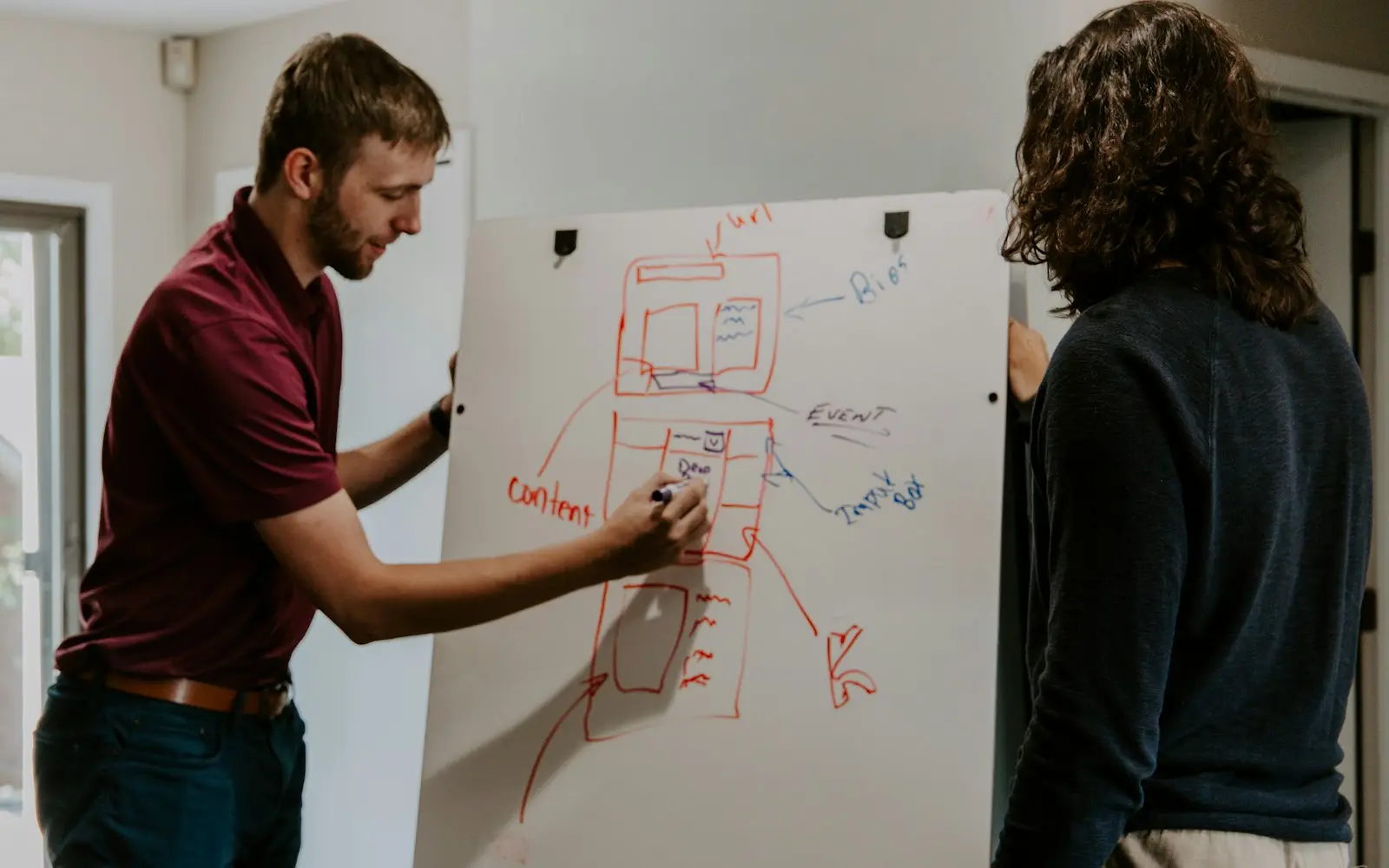
Founders often arrive with a complete product vision and a runway that covers a fraction of it. The real work is deciding which slice of that vision actually tests the core hypothesis, and admitting that parts of the workflow can stay manual, or run through a spreadsheet, for the first cohort of users.
Technical debt that shows up in due diligence
An investor's technical reviewer reads commit history, test coverage and dependency choices, not just the product demo. A shortcut that made sense at fifty users can read as a warning sign at a term sheet stage if nobody wrote down why it was taken or when it was meant to be removed.
Handing the codebase to your first in-house hire
At some point the company hires its own CTO or a small engineering team, and that person inherits every architectural choice made before they arrived. Without documented decisions and a clean environment setup, the handover turns into weeks of tracing history instead of a straightforward onboarding.
Every sprint competing against runway
Each feature has to be justified against months of cash left, not against a long-term roadmap. Capabilities that matter at scale, granular permissions, multi-region infrastructure, single sign-on, usually have to wait until there's revenue or funding that justifies building them early.
Proving traction to the next check
Whether the next round comes from an accelerator, an angel or a venture fund, the product has to show usage, retention or a repeatable sales motion. That shapes what gets instrumented from the first release, rather than added right before a fundraising conversation starts.
How we adapt
How we work differently for you
Engagement
Work starts as a short, focused discovery pass rather than a long specification phase, followed by rolling time and materials sprints instead of one large fixed-price contract. Scope is expected to move once real users start clicking through the product, and the contract structure moves with it.
Team
A small, senior-heavy team, often a lead engineer plus one or two others, replaces the larger multi-role team a bigger company might use. A handful of people who each understand the whole system tend to outpace a larger group that needs a project manager just to stay aligned.
Process
Cycles stay short enough that a founder has something new to show a real user every week or two. Decisions get written down in a short architecture note, so a future hire or an investor's technical reviewer can reconstruct why a choice was made.
Budgeting
Spend gets phased against funding milestones instead of planned as one multi-year budget: a pre-seed prototype, a seed-stage MVP, then hardening once a round closes. Each phase gets re-scoped against what the previous phase's users actually did, not what the original pitch deck assumed.
Handover planning
Code lives in the founder's own repository and cloud account from the first commit, with environment variables, access and setup steps documented as they're created. When the company is ready to hire its own engineers, the transition is an onboarding exercise rather than a reconstruction project.
Projects
What we typically build
MVP build for a pre-seed product
A single core workflow, built end to end and scoped tightly enough to test one hypothesis with an early cohort before the next funding conversation.
Adding a payments layer to prove monetization
Subscription or transaction billing added to an existing prototype once the product needs to show that users will actually pay, not just sign up.
Rebuilding a no-code prototype in production code
Moving a validated idea off a no-code tool once usage outgrows what the tool can handle, without starting the validation work over from the beginning.
Instrumenting analytics ahead of a fundraise
Adding activation, retention and usage tracking so a founder walks into investor meetings with real numbers instead of a description of the product.
Hardening authentication and data models before a review
Cleaning up the parts of an MVP that get scrutinized in a technical review: access control, test coverage on payment paths, and a data model that matches what the product actually does today.
Engagement
Engagement models that fit
Most startup engagements run on time and materials with a capped first sprint, priced to answer a specific question rather than deliver a fixed feature list. Code and infrastructure access transfer to the founder as they're built, so there's no lock-in if priorities change after a pivot or a board meeting. Team size flexes with funding: it scales up once a round closes and back down when a founder needs to stretch a smaller amount of runway further.
For startups planning to hire their own engineering lead within the next year, the engagement includes documentation and a defined handover point from the start, so the transition doesn't depend on re-explaining decisions nobody wrote down.
FAQ
Frequently asked questions
How small can an MVP be and still be useful for fundraising?
Small enough to test one clear hypothesis with real users. Investors respond more to evidence that people use and pay for something than to a long feature list, so a narrow, working core workflow with early usage data tends to land better than a broader product with no traction behind it.
Will our codebase hold up to a technical due diligence review?
That depends on what gets prioritized during the build. We keep commit history readable, document decisions as they're made, and add test coverage on the paths that matter most, such as authentication and billing, so a reviewer can follow the choices instead of guessing at them.
What happens when we hire our own engineers?
The repository, cloud accounts and documentation are already yours, so the new hire onboards onto a system with a written history instead of reverse-engineering it. We can also stay on in a smaller advisory role during the transition if that's useful.
Do you sign an NDA before we share our idea?
Yes, before any detailed discovery conversation, and we avoid building directly competing products in the same narrow niche while we're engaged with you.
Can you work for equity instead of cash?
We price engagements in cash fees rather than equity, since that keeps incentives clear on both sides and doesn't tie your cap table to a services relationship. Fees can flex with a phased scope if cash is tight before a round closes.
Services
Services we usually start with
- Custom Software DevelopmentWe build software around the processes your business already runs on, so operations stop depending on spreadsheets, workarounds and tools that were never built for your workflow.

- SaaS DevelopmentWe build multi-tenant SaaS products around tenant isolation, subscription billing and self-serve onboarding, architected to scale past your first cohort of customers.

- Mobile App DevelopmentWe build native and cross-platform mobile apps, handle App Store and Play Store submission, and design for the offline gaps and device permissions a phone actually has to deal with.

- UI/UX DesignResearch, flows and prototypes tested against real users, handed to engineering as a working Figma design system instead of a static file.

- Cloud & DevOpsWe design cloud infrastructure as code, build CI/CD pipelines, and get your team ready for incidents before they happen.

Solutions
Common systems
- MVP DevelopmentWe turn a product idea into a working release built around the one thing you need to prove, not a shortened version of the whole vision.
- Subscription Billing SystemsRecurring billing that gets proration, failed payment retries, and tax calculation right, built on a billing platform rather than reinvented from zero.

- Internal Tools & Admin DashboardsBack-office software that lets your team look up, edit, and act on production data safely, replacing the spreadsheet or the direct database query.

- AI Chatbot DevelopmentA chatbot that answers from your own documentation, takes real actions inside your systems, and knows when to hand a conversation to a person.

Industries
Industries we often work in
- Fintech & BankingLedger-accurate financial software with KYC/AML checks and PCI DSS-aligned payment flows built in from the schema up.

- HealthcareClinical and patient-facing software built to HIPAA technical safeguards, wired into the EHR your care teams already use.

- Retail & E-commerceInventory, POS and storefront software that stays in sync across every channel, with EDI wired in for your wholesale partners.

- Professional ServicesEngagement management, time tracking, and client portals built around the way consulting and advisory firms actually bill for their time.

Insights
Planning guides
- 8 min readHow to Build an MVP Without Wasting Budget on the Wrong FeaturesA practical guide to how to build an MVP: scoping the smallest viable version, validating demand, choosing an engagement model, and avoiding common mistakes.
- 7 min readHow Much Does Mobile App Development Cost?Mobile app development cost typically runs from $25,000 for a simple utility app to $300,000+ for a two-platform app with offline sync and payments.

- 7 min readHow Much Does MVP Development Cost?MVP development cost typically runs $15,000 to $60,000 for a single-workflow product, and $60,000-$150,000+ once billing or integrations are involved.

Also
Other kinds of clients
- Custom Software for Small BusinessesWe phase custom work around your cash flow, integrate what you already pay for, and say plainly when buying is smarter than building.

- Enterprise Software DevelopmentWe work inside your security review and procurement process, integrate with the legacy systems you can't replace overnight, and plan for the change management a rollout needs.

- White Label Software DevelopmentWe deliver under your brand, sign NDA and non-solicitation terms upfront, and hand code ownership to your client the way your own team would.

Tell us what you need built
Share a few details about your project. A senior engineer reviews every request and replies with next steps, questions, and a rough budget range.